A new Federal Reserve chair nominee, Kevin Warsh, is expected to take office in May, marking the end of Jerome Powell’s term. While Powell’s chairmanship formally concludes then, he is not required to leave the Fed altogether. Powell could remain on the Board of Governors until January 2028, and if he chooses to do so, it would make things that much more interesting. A former chair serving alongside his successor would introduce an unusual dynamic at a moment when the Fed is still reckoning with the consequences of its post-pandemic policy decisions.
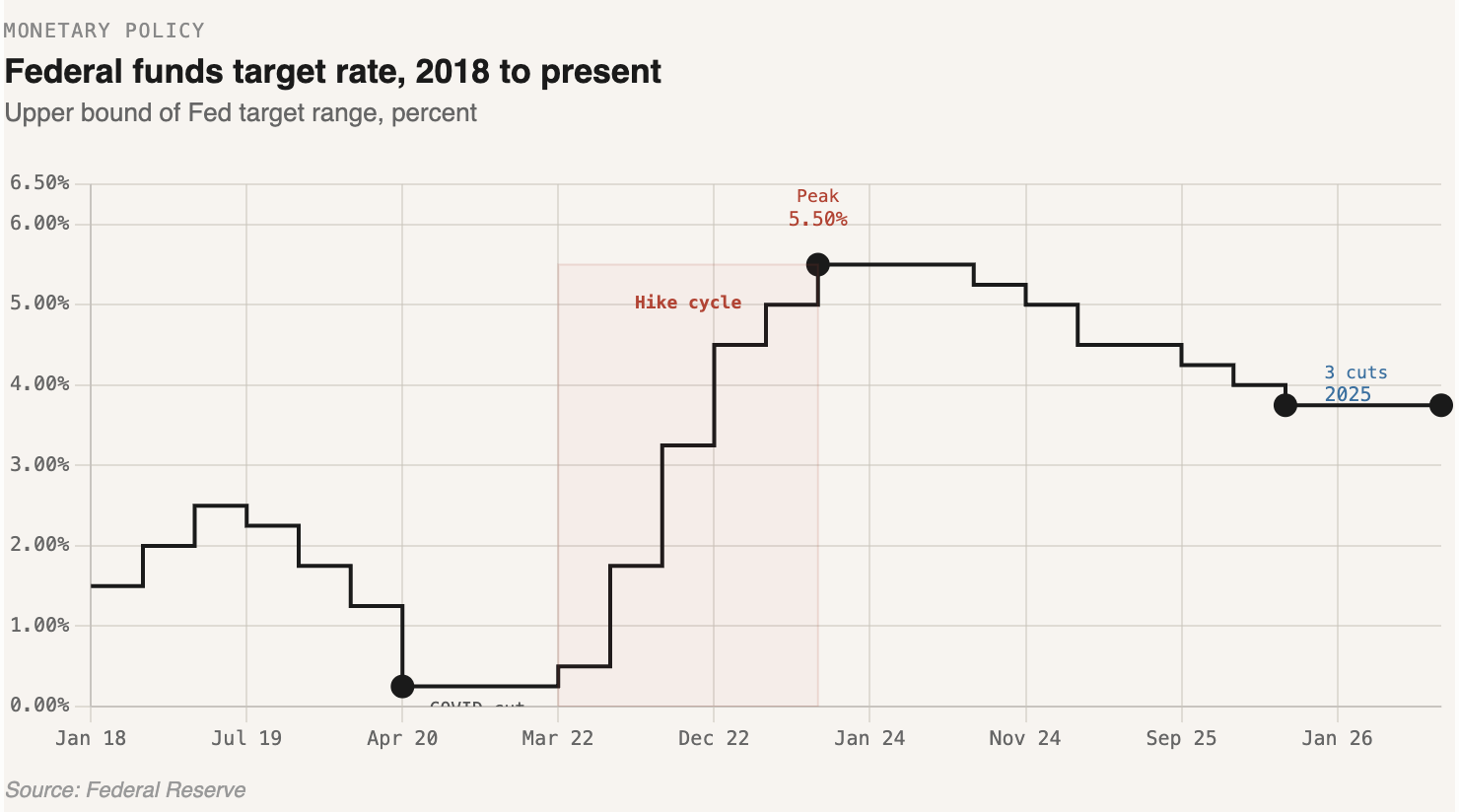
At a high level, both Powell and Warsh believe deeply in the importance of central bank credibility. Both view inflation expectations as the cornerstone of monetary policy and agree that once those expectations slip, restoring them becomes far more costly. Warsh has repeatedly argued that inflation is a policy choice, not an unavoidable outcome of shocks, a critique that implicitly targets Powell’s embrace of the transitory inflation narrative in 2021. Powell, for his part, ultimately acknowledged that assessment in practice, pivoting aggressively in 2022 with one of the fastest tightening cycles in modern Fed history.
Where they diverge is not in diagnosis but in timing and framing. Powell is willing to absorb short-term credibility damage in exchange for flexibility. His emphasis on labor market resilience, financial stability, and risk management reflects a belief that policy errors can be corrected incrementally. Warsh is far less forgiving of delay. He has criticized the Fed for moving too slowly, for expanding its balance sheet well beyond crisis necessity, and for broadening its mission in ways that dilute its focus on price stability. In Warsh’s telling, Powell’s Fed did not merely misjudge inflation, it rationalized it.
That critique resonates with many market participants who have long argued that quantitative easing evolved from an emergency tool into something closer to a standing feature of the policy framework. Warsh has positioned himself closer to a monetarist tradition, emphasizing balance sheet discipline and tighter control over money supply. Whether that diagnosis translates into materially different policy is far less clear. History suggests that talking about balance sheet cleanup is far easier than executing it without creating unintended stress in funding markets, a constraint that may ultimately limit how different a Warsh Fed can be in practice.
Warsh’s critique also carries its own vulnerabilities. During his tenure as a Fed governor in the run-up to the 2008 financial crisis, he was consistently focused on inflation risks even as the economy was deteriorating rapidly. Inflation did not materialize in the way he feared, while deflationary forces and financial collapse dominated the period that followed. His opposition to QE2 in 2009 likewise placed him on the cautious side of history, as the subsequent recovery unfolded alongside years of low inflation despite unprecedented stimulus.
Powell was late to recognize inflation persistence after the pandemic. Warsh was early to warn about inflation when demand was collapsing. Both errors stem from the same underlying challenge, interpreting an economy in transition through imperfect signals. Warsh criticizes Powell for overextending QE and holding rates too low for too long, but his own record reflects a tendency to emphasize inflation risks at moments when the dominant threat lay elsewhere. Each, in different eras, leaned too heavily on the lesson of the previous crisis.
That pattern resurfaced more recently. Warsh went from arguing that inflation remained too high and policy should stay restrictive to calling for rate cuts by late 2024. Critics framed the shift as politically motivated, and the timing certainly raised eyebrows. To be fair, the pivot coincided with a surge in optimism around AI-driven productivity gains and the idea that stronger productivity could support lower rates without reigniting inflation. Still, Warsh’s willingness to accuse the Fed of moving the goalposts sits uncomfortably alongside his own changes in posture, particularly when those shifts align closely with changes in political leadership.
Warsh has also faulted Powell for blurring the Fed’s boundaries, arguing that forward guidance, balance sheet activism, and expanded policy objectives have made the central bank too political. That critique resonates, yet it is difficult to ignore that Warsh’s recent public commentary increasingly overlaps with political narratives, particularly in his calls for regime change and structural overhaul at the Fed. In positioning himself as the antidote to Powell, Warsh risks replicating the very credibility problem he accuses the institution of creating.
It is nearly impossible to discuss Federal Reserve chairs without bringing up Paul Volcker. Volcker confronted inflation that was deeply embedded in the economy and chose to attack it directly, regardless of the economic pain or political backlash that followed. He constrained money supply growth, allowed interest rates to rise to levels that shattered demand, and refused to retreat when pressure mounted. Volcker did not attempt to manage expectations gently or calibrate outcomes in real time. He imposed discipline and waited for the economy to adjust.
Neither Powell nor Warsh has demonstrated a comparable willingness or ability to operate that way. Powell’s Fed has prioritized stability and continuity, often at the expense of decisiveness. Warsh’s rhetoric evokes Volcker’s discipline, but his historical record suggests a preference for caution when faced with real economic stress. Both operate in a financial system far more leveraged, politicized, and fragile than Volcker’s, making the costs of standing one’s ground substantially higher.
The more uncomfortable truth is that the Volcker era may be less a template than an anomaly. Today’s Fed chairs are expected to thread needles Volcker never had to consider, preserving financial plumbing, managing asset prices, and navigating fiscal dominance, all while claiming independence. In that environment, the debate between Powell and Warsh is less about who is right and more about how much credibility the Fed can afford to spend, in a system where standing one’s ground is no longer just a matter of will.

Leave a Reply