
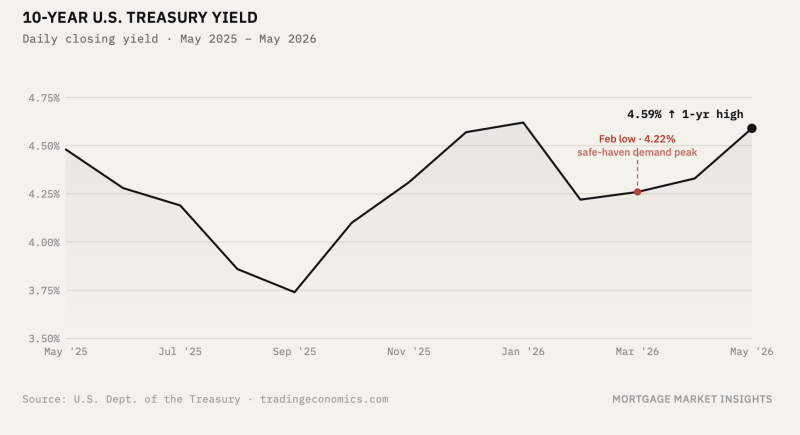
Kevin Warsh has spent seven weeks telling markets he’ll raise rates if inflation requires it. The bond market has spent seven weeks quietly testing whether he means it. But the more useful question isn’t whether Warsh wants to hike. It’s whether the federal government’s own balance sheet allows for it.
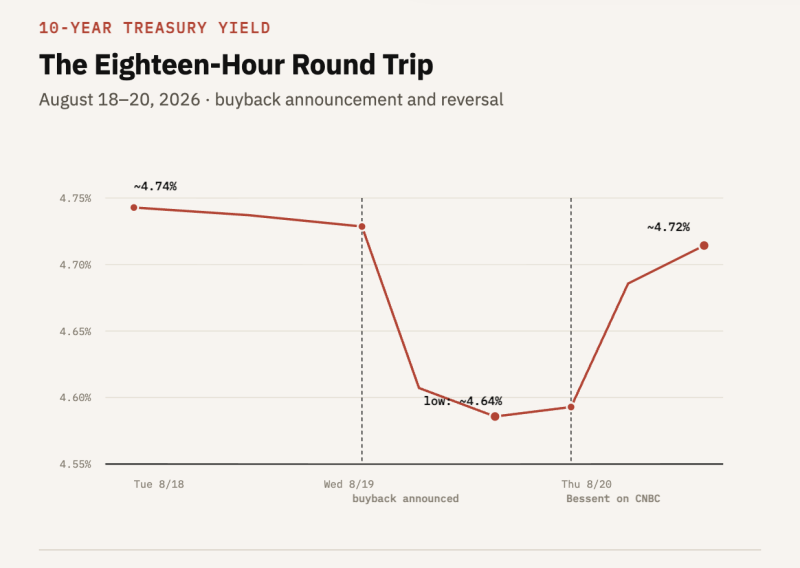
Net interest on the national debt is on pace to top $1 trillion this fiscal year, already ahead of Medicare. The Treasury just held coupon auction sizes flat for the fourth straight quarter, leaning on bills to cover the gap instead. And in the background, the administration has spent the last three weeks actively engineering ways to keep the long end of the Treasury curve from rising. None of that is inflation fighting behavior. It’s damage control on a balance sheet that can’t absorb what a real hike would do to it.
T-Bill and Chill
The present issuance strategy didn’t start with Bessent. Janet Yellen leaned into short-term bills starting in late 2023 to fund the deficit rather than terming out into longer coupons, betting rates would fall before the debt needed refinancing. Bessent, before taking the job, called this reckless, amplifying an analysis accusing Yellen’s Treasury of “activist” issuance designed to flood the market with bills and hold down long-term yields.

Then he took the job and kept doing it. Every quarterly refunding since has held coupon and auction sizes flat, pushing financing needs into bills. Traders now call this “T-bill and chill.”
The effect is exactly what he warned about. A deficit north of $2 trillion a year is financed overwhelmingly at the short end, on a bet that rates fall before this debt rolls. This is what makes a Warsh hike so dangerous to the government’s own books: every point added at the front end reprices a mountain of bills within twelve months, almost immediately rather than over a bond’s life. The strategy Bessent once called foolish is now the reason his own boss’s Fed has so little room to maneuver.
Treasury Is Already Fighting For Yields
In late July, with the yen sliding toward 40-year lows, the U.S. joined Japan in a coordinated intervention, buying yen directly. Bessent’s own notepad, photographed at a Camp David cabinet meeting, read “To Do: Buy Japanese Yen $5-10 bil.” Japan cam eup with another $60 to $80 billion to buy their currency. Standard FX intervention, nothing structurally new.
What came next is far more interesting. Bessent is now pushing Warsh’s Fed to expand the FIMA repo facility, essentially a repo market for foreign central banks. This allows lets foreign central banks post Treasuries as collateral and borrow dollars overnight rather than selling those Treasuries outright. Japan is the largest foreign holder of U.S. debt. If it needs more dollar firepower to keep defending the yen, the blunt option is to liquidate part of that stack, which would add real selling pressure to the Treasury market at the worst possible moment. The FIMA route lets Japan raise dollars without ever touching the open market with its Treasury holdings.
Treasury was willing to spend its own dollars on direct intervention, but the moment the conversation turned to giving Japan more capacity, the preferred tool was collateralized borrowing, not sales. This is not currency policy. This is purely a yield defense play. The administration is treating a large foreign holder becoming a forced seller as a live risk.
The Math That Makes a Hike Self-Defeating
A meaningful chunk of outstanding Treasury debt is bills, maturing inside a year, and the August refunding leaned even harder into that mix. Treasury needs to borrow roughly $739 billion from private investors this quarter alone, July through September.
This structure means a fed funds hike doesn’t stay contained to new borrowing. It reprices a huge slice of the existing debt stock within twelve months, because so much of it rolls that fast. Net interest costs are already running above $1 trillion a year, ahead of Medicare and defense. Every basis point Warsh adds at the front end doesn’t just tighten financial conditions for households and businesses. It shows up almost immediately in the government’s own interest bill, at a moment when the deficit is already being patched with bills instead of longer paper. Warsh framed the Fed’s next move as a pure inflation call. Inflation is the stated reason. The debt structure is the actual constraint.

The Greenspan Conundrum, and Why It Might Not Hold
The Fed has hiked before and watched the long end barely move, sometimes even fall, the argument being that a hike today is really just removing tomorrow’s inflation. Between 2004 and 2006, Greenspan raised the fed funds rate 425 basis points while the 10-year yield rose only a few tenths of a point. He called it a conundrum. If the long end shrugged off a hike then, maybe it would now, and maybe mortgage rates would too.
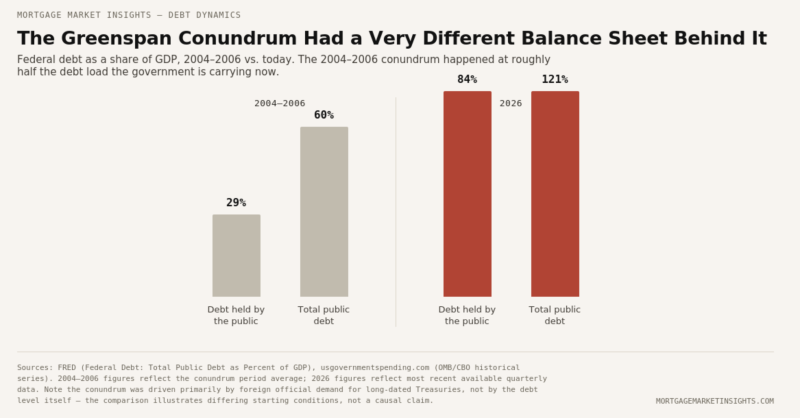
The comparison doesn’t hold up once you look at what was actually driving it. Debt held by the public (this is the stuff that actually gets traded) sat around 29% of GDP during the conundrum years, with total public debt (includes government holdings) around 60% of GDP. Today, debt held by the public is near 84% of GDP, and total public debt is above 120%. That’s a different government balance sheet by any measure.

More importantly, the conundrum was a demand-side story. Asian central banks were recycling enormous trade surpluses into long-dated Treasuries to keep their own currencies weak, and that wall of buying suppressed long yields regardless of what the Fed did with the front end. Today’s setup runs in the opposite direction. Japan just needed U.S. help defending its own currency, not the other way around. There’s no equivalent flood of foreign demand standing ready to absorb a hike-driven repricing at the long end. What’s driving today’s story is supply and duration, a government financing itself short because it can’t afford to term out its debt at current rates, not a foreign buyer base propping up the long bond out of its own self-interest.
The 2004-2006 conundrum was a gift the Fed happened to receive. This time, if Warsh hikes, there’s no obvious mechanism handing him the same reprieve.
What This Means for Mortgage Rates
None of this means Warsh won’t hike. It means that if he does, the transmission to mortgage rates looks less like 2004-2006 and more like a direct hit. Without the foreign-demand cushion that absorbed the last hiking cycle at the long end, a fed funds increase has a more plausible path into the 10-year, and from there into primary mortgage rates and MBS spreads, than the conundrum precedent would suggest.
This leaves mortgage rates with very little room to fall from here. The bond market is already doing the enforcement work Warsh won’t, the debt structure rules out the kind of long-end relief that we saw in 2004-2006, and Treasury’s own financing choices are a tell that even the government doesn’t expect lower rates anytime soon. Absent a real growth scare or a sharp downside surprise in the data, current levels look like the floor, not a stop on the way down. The more likely path from here is sideways to higher.
Leave a Reply