
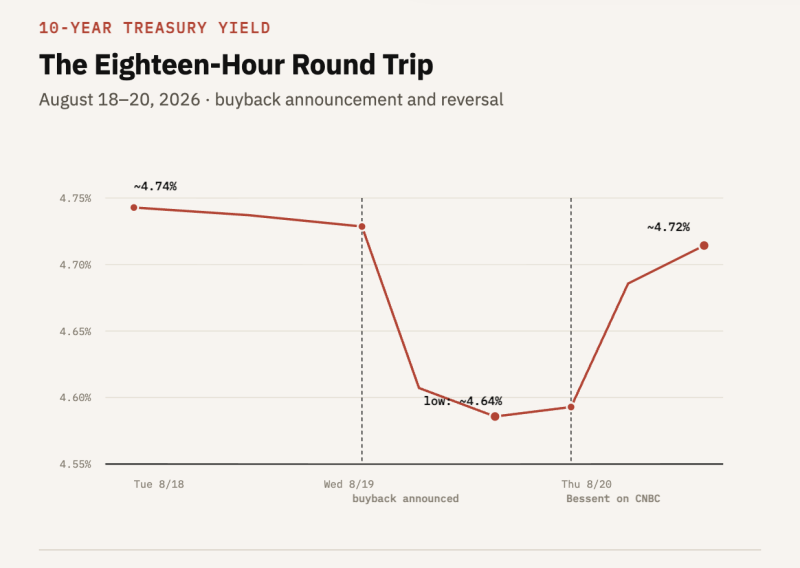
The Treasury just proved it can move yields for about eighteen hours. It doubled the cap on its long-dated buyback operations, from $2 billion to at least $4 billion, and yields on the 10-year dropped. By next morning, after Bessent went on CNBC and teased even bigger operations plus a coming “fiscal consolidation” push, the 10-year had climbed back above 4.7%, erasing the entire move and then some.

The buyback doubling worked exactly as intended on Wednesday, then Thursday’s follow-through commentary undid it, because the market isn’t pricing a liquidity problem, it’s pricing a solvency trajectory. CBO has net interest hitting $2.1 trillion by 2036, already past defense spending, and no buyback program sized in single-digit billions touches that math. Bessent clearly understands the mechanism (he’s said as much, calling it a signal that yields don’t reflect fundamentals) but the execution reads reactive: doubling a program mid-quarter, days after a refunding announcement that gave no hint, is not what a team operating from a position of strength does. This should have been standing policy at least a year ago, scaled and telegraphed, not deployed as an emergency brake during an August liquidity air pocket.
Why the reversal is the real signal
The market is telling us what it actually thinks. This buyback program cannot move the supply-demand balance enough to matter on its own. Its only real power is as a signal. Treasury’s own August refunding raised $125 billion in new coupon debt in a single week. A buyback operation capped at $4 billion, even doubled, is a rounding error against that supply, closer to a press release than a market intervention. And once the market decides the signal is “we’re worried about long-end funding costs” rather than “there’s a technical liquidity glitch we’re smoothing over,” the signal starts working against you. Doubling a buyback program with no notice, in the middle of a quarter, looks like exactly what it is: a reactive move dressed up as a proactive one.

Why Stop at $4 Billion?
Late last year regulators finalized a rule easing the supplementary leverage ratio for the largest banks, specifically to free up dealer balance sheet capacity for Treasury market intermediation, and that relief has been in effect since spring. The Fed, OCC, and FDIC replaced the old flat 2% capital buffer for GSIBs and their subsidiaries with one set at half of each bank’s risk-based systemic surcharge, capped at 1% for subsidiary banks. The FDIC’s own estimate put the reduction at $219 billion, or 28%, in capital requirements at the subsidiary level specifically, which is where the actual day-to-day Treasury market-making happens. Regulators framed this explicitly as Treasury market policy, not just bank policy, meant to let dealers absorb more government debt without hitting balance sheet limits, especially with mandatory central clearing for Treasuries phasing in around the same time. So, dealers should have more room to warehouse Treasuries right now than they did a year ago. That makes the size of this buyback even more questionable. Given how small the cap was, and how fast yields reversed back to their prior levels anyway, it’s worth asking whether Treasury actually has more room to work with here, or whether $4 billion was never meant to hold the line at all, just a test run to gauge the market’s reaction before deciding how big the real program needs to be.
The debt problem underneath it
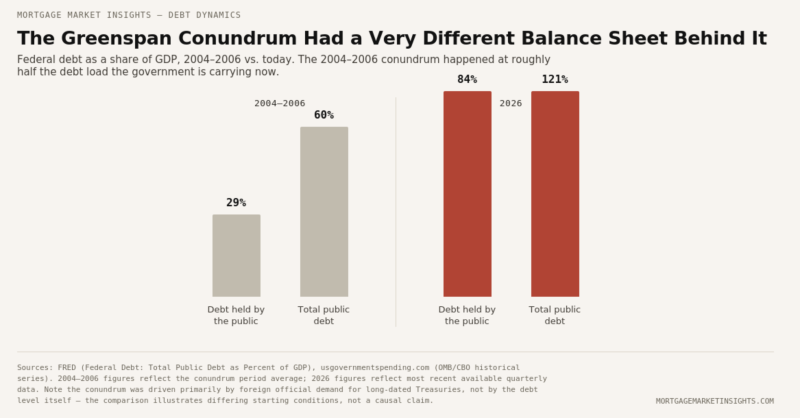
CBO’s February baseline has net interest expense hitting $1.0 trillion in fiscal 2026, on its way to $2.1 trillion by 2036. Interest already costs more than the government spends on national defense. Debt held by the public sits at 101% of GDP today and CBO has that climbing to 120% by 2036, a level not seen since the tail end of World War II. None of that is news, but it’s the backdrop that makes this buyback episode make sense.
The Fed isn’t offering the market any more clarity than Treasury is. Warsh’s July FOMC meeting was read as dovish in the room and hawkish on a second read of the transcript, with three dissents pushing for a hike the same day the committee held steady. Warsh has been explicit that he wants the Fed talking less and the market pricing more off the data itself. That sounds disciplined, but it means a Fed chair who won’t commit to a signal and a Treasury Secretary whose signal doesn’t hold are both landing on the same desk at the same time. Rates desks are being asked to hedge against two institutions that are each, in their own way, back and forth about where they stand.
The timing problem, and what it means for mortgage rates
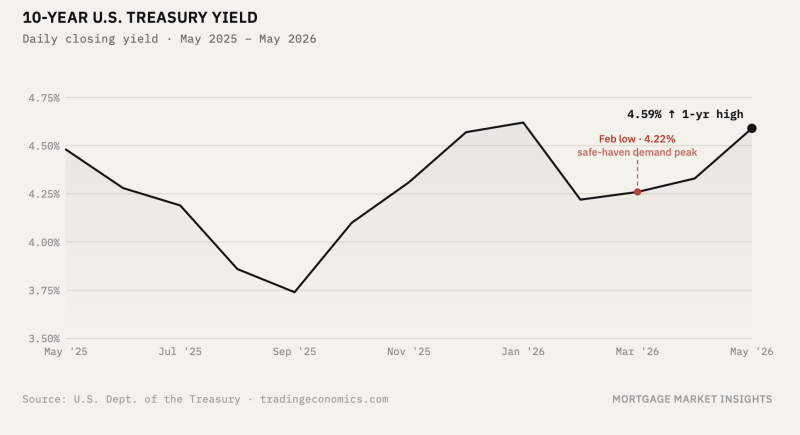
Long-end yields have been under upward pressure for months, driven by the same fiscal math that’s true today and was true then. If the plan was always to use buybacks as a signaling tool to support the long end, doing it early and telegraphing it as standing policy would have built credibility before the market needed convincing. Instead, it arrived as a scramble during a thin August trading week, right as an unrelated geopolitical shock (Bessent himself pointed to the Iran conflict as a distorting factor) was already muddying the read on where yields “should” be. Deploying a new tool for the first time during a period when nobody can cleanly separate signal from noise is the worst possible moment to find out whether the tool works. And now the market has one data point suggesting Treasury will blink under pressure, which of course adds more volatility to the future rate path.
For mortgage rates, the transmission is direct even though the actors are different from the Fed cutting or holding. The 10-year is still the anchor for the mortgage-to-Treasury spread, and MBS pricing desks watch long-end Treasury stability as a proxy for how much term risk they need to hedge against. A Treasury market that pops and fades within a day on policy headlines is a harder market to hedge a pipeline against. Every basis point of added volatility at the long end shows up as wider spread compensation demanded by MBS investors, because nobody wants to hold prepayment-sensitive paper against a Treasury curve that might move 10 basis points on the next Bessent CNBC hit. If this is the preview of how buyback policy gets run going forward, reactive, unsignaled, and quick to talk itself out of its own gains, that’s a mild net negative for mortgage rate stability, even on days when the headline move is lower yields. Rate levels matter, but so does the market’s confidence in how the level got there. Right now that confidence is thin, and thin confidence gets priced.
Leave a Reply